|
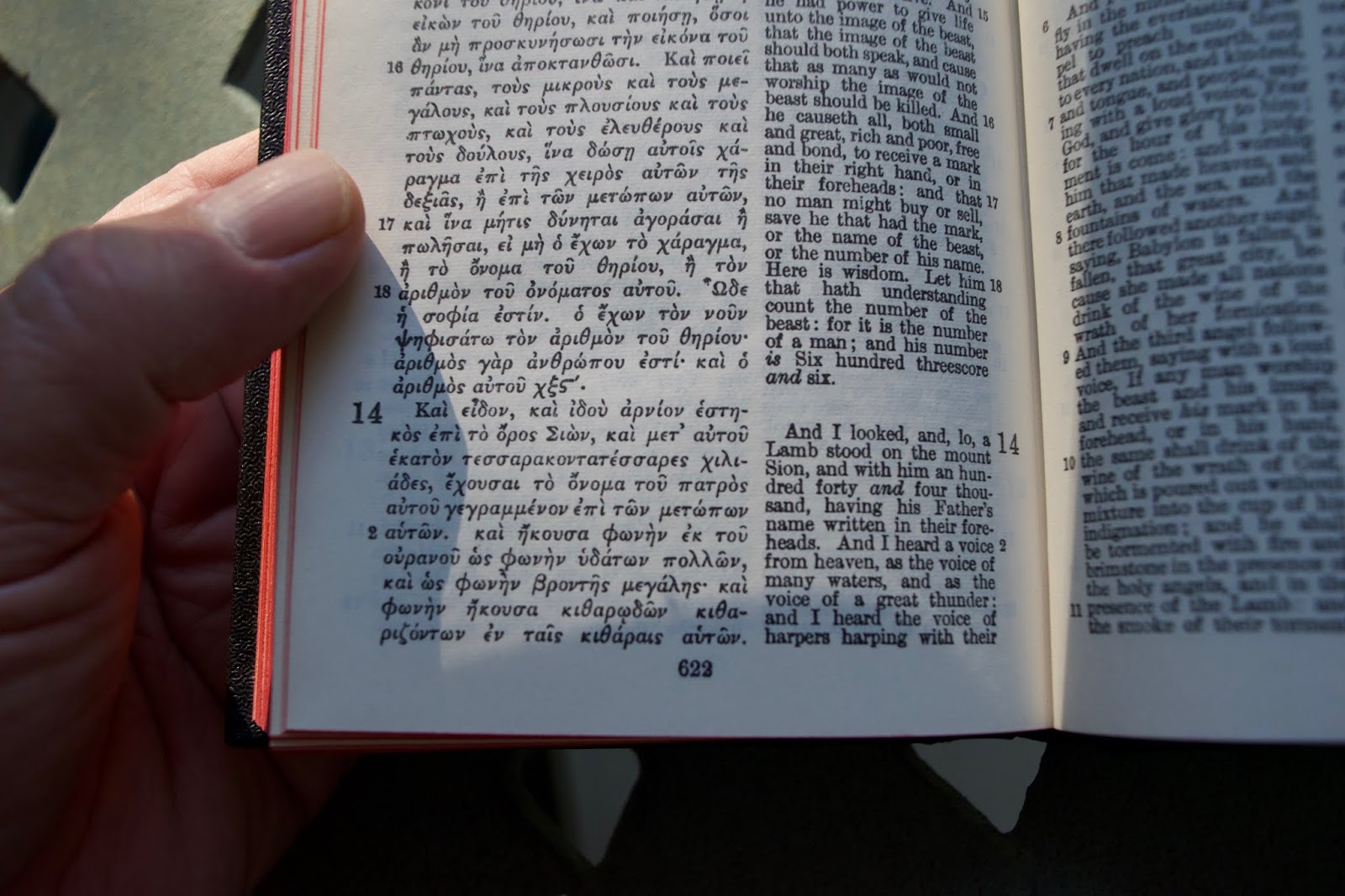
| Image: The Received Greek Text of the New Testament (British and Foreign Bible Society) |
One of my problems with the modern critical text of the Greek New Testament is that it places access to the original Greek of the New Testament beyond the ability of ordinary Christians. This is due mainly to the modern critical text's dependence upon (hand written) manuscripts, which the average Christian has little-or-no access to. And, even if we did, the sheer number of manuscripts and fragments of the Greek New Testament (5,000+) is too vast for ordinary Christians to process.
As a Christian with a working knowledge of New Testament Greek, I can easily access many of the (27) printed editions of the Renaissance/Reformation era Greek New Testaments, either in print or online, and I can make my own comparisons and determinations regarding variant textual readings. I do not need priest-scholars in Münster providing me with their esoteric occult (=hidden) knowledge of the Greek text (think especially CBGM here) because I can access the Greek text for myself. And this access to the text of the Greek New Testament by ordinary Christians was, I think, one of the reasons for reforming the church during the 16th century.
What we need today is a renewed priesthood of ordinary believers who can determine—for themselves—what the text is according to the various printed editions of the 16th and 17th (and later) centuries.
We don't need modern textual criticism in order to do this. We can do this ourselves. We simply need a working knowledge of New Testament Greek.
What we don't need are priest-scholars in Münster handing down to us their critical text, which they expect us to receive uncritically.
++++
Learn New Testament Greek...
John H. Dobson, Learn New Testament Greek https://www.amazon.com/Learn-Testament-Greek-John-Dobson/dp/0801017262
Online editions...
1514 Complutensian Polyglot https://www.wdl.org/en/item/10636/
1516 Erasmus 1st Novum Instrumentum omne https://cudl.lib.cam.ac.uk/view/PR-C-00002-00009
1519 Erasmus http://www.bibles-online.net/1519/
1521 Erasmus http://www.bibles-online.net/1521/
1550 Robert Estienne (Stephanus) 3rd - Editio Regia https://biblehub.com/tr/matthew/1.htm
1598 Beza http://textusreceptusbibles.com/Beza
1624 Elzevir http://www.textusreceptusbibles.com/Elzevir
1894 Scrivener https://biblehub.com/tr94/matthew/1.htm
1904 text of the Ecumenical Patriarchate of Constantinople https://www.goarch.org/chapel/greek-new-testament
Print editions...
The New Testament of our Lord and Saviour Jesus Christ: According to the Received Greek text (Elzevir 1624) together with the English Authorised Version (arranged in paragraphs) http://net.ondemandbooks.com/google/A2EwAQAAMAAJ
The Greek and English Testament (Stephanus 1550) together with the English Authorised Version arranged in parallel columns (verse by verse) Edited for the Syndics of the University Press Cambridge, by James Scholefield http://net.ondemandbooks.com/google/WM9DAQAAMAAJ
George Ricker Berry Interlinear Greek-English New Testament (Stephanus 1550 and KJV) https://www.amazon.com/George-Ricker-Interlinear-Greek-English-Testament/dp/B00RWQAQWM
Scrivener TBS printed edition (primarily Beza 1598) https://www.amazon.com/Koine-Greek-Testament-Trinitarian-Bible/dp/1862280975